

An Indian wedding in Dubai isn't a single event. It's four to six separate ceremonies across two to four days — each with its own emotional register, its own light conditions, its own crowd dynamics, and its own must-have photographs.
A photographer who delivers one wedding day brilliantly but has never shot a Haldi or a Sangeet is not equipped for this brief. Here's what genuine experience looks like.
The Events — What Each One Requires Photographically
Haldi
Chaos, joy, turmeric paste and laughter. The photography challenge: it's almost always shot in daylight, often outdoors or by a pool, with subjects being smeared with yellow paste who are not going to pause for a composed frame. The best Haldi photography is fast, observational and shot from multiple heights. A photographer who's worried about their camera getting dirty will move too slowly. Ask specifically for Haldi samples — not just a general portfolio.
Mehendi
Slower, more intimate, more about the details. The bride's hands, the patterns, the family gathered around her, the informal conversations happening on the side. This rewards a documentary instinct and a 50mm or 85mm prime lens — not a wide-angle shooter hunting for the big room shot. The Mehendi is often the first event, which means it sets the tone for the family's comfort with the camera. A photographer who connects well here gets better photographs at every event that follows.
Sangeet
The most technically demanding event. High-energy performances, changing coloured stage lighting, fast movement and a crowd that wants to be captured. The photographer needs to be fluent in bounce flash and off-camera flash in a coloured-light environment without making every image look like on-camera flash was used. This is a specific skill that most generalist photographers haven't developed. The Sangeet is also the best event to source same-day edit content from — a few killer frames and short clips your couple and guests can post on Instagram stories that same night. If you want same-day delivery, plan the Sangeet coverage around it from the start, not as an afterthought.
Baraat
The simultaneous coverage problem. The groom's procession is arriving at the front of the venue. The bride is in the bridal suite at the back. Both are happening at the same time. One photographer cannot cover both. The lead typically stays with the bride for the final preparation and first-look moment; the second shooter covers the baraat. If a photographer quotes you solo coverage for a full Indian wedding, this is the moment you understand why that's insufficient.
Nikah or Hindu Wedding Ceremony
The ceremony is where the sacred moments live. For a Hindu ceremony: the Saptapadi, the Sindoor, the Vidai. For a Nikah: the Ijab-Qabul and the signing of the nikahnama. These moments cannot be recreated. The photographer must know the ritual well enough to anticipate rather than react. A photographer who has shot fewer than twenty Indian weddings doesn't have that fluency. Ask.
What Cultural Fluency Actually Means
Cultural fluency isn't knowing the names of the ceremonies. It's understanding the emotional weight of each moment, the family dynamics around it, and the visual language that makes a photograph of that moment land.
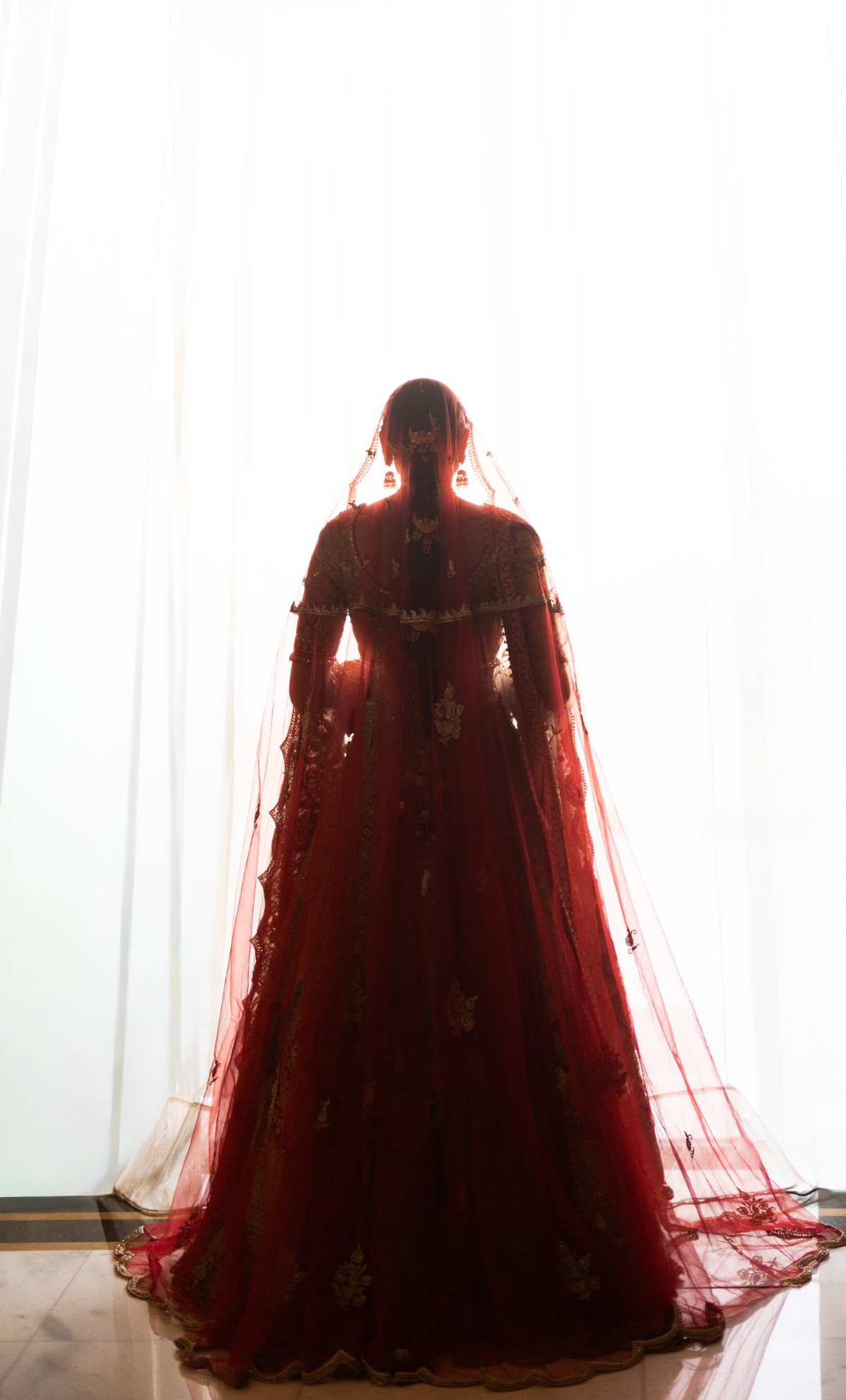
The Vidai — the bride leaving her family — is one of the most emotionally intense moments of any Indian wedding. A photographer who doesn't understand its weight will be in the wrong position when it happens. One who does will have already anticipated where the bride's mother will be standing, where the light will fall, and how close to get without intruding. The same applies to the father-daughter moment at the mandap, the groom's face when the bride enters, the grandparents watching from the side. These images aren't planned — they're earned through experience and presence.
Dubai-Specific Challenges for Indian Weddings
- Permit coordination is more complex than in India. Drone coverage of the baraat or the wedding exit at a Dubai venue requires a DCAA permit and often venue-specific clearance on top of that. A photographer who says they'll sort permits on the day has not sorted permits.
- Venue lighting is more extreme. Indian wedding decor in Dubai tends toward heavy colour — deep reds, magentas, golds — against hotel lighting that's already warm. Managing colour cast without desaturating the decor couples have spent thousands on is a specific skill. Ask to see reception images from inside a heavily decorated Dubai ballroom, not just outdoor or pre-function shots.
- Travel logistics affect crew quality. A photographer flying in from Mumbai or Bengaluru for a single Haldi and returning the same day isn't bringing their best. Multi-day Indian weddings in Dubai deserve a crew that arrives the day before, does a venue walkthrough, and leaves the day after. Budget crew accommodation as part of the photography cost.
Planning a multi-day Indian wedding in Dubai?
Tell us your events and your venue. We'll send you a shot plan for your specific Indian wedding schedule and our Dubai venue portfolio — within 24 hours.
Talk to UsPrefer a form? Send us your details → — reply within 24 hours. Browse our latest UAE work at weddingclickz.com.
Frequently Asked Questions
Should we book a photographer from India or one based in Dubai?
The best Indian wedding photographers working in Dubai today are often India-based teams that travel regularly to the Gulf. The relevant criterion is UAE venue experience, not base location. Ask for Dubai-specific samples and for references from Indian families who married at similar venues.
How many photographers do we need for a four-event Indian wedding?
Minimum: one lead photographer, one second shooter for photos; a two-person film team. Recommended for a 250-plus guest wedding: two photographers, one film director, one film operator, one drone operator. That's five to six people across photo and film.
What is a same-day edit and do we need one?
A same-day edit is a short highlights sequence — usually sixty to ninety seconds for photos, two to three minutes for film — delivered the morning after the wedding. For Indian weddings in Dubai where guests from multiple cities are still together the next morning, it's worth every dirham. Plan for it from the start.
How do you handle multi-community weddings?
We cover Hindu, Muslim, Sikh and Christian ceremonies regularly — often in combination for interfaith couples. Brief us on the specific rituals you want covered, the religious protocols around photography at each ceremony, and any family members who shouldn't be photographed. We carry written briefs on the day so nothing is left to memory.
Can you match the style of another photographer we love?
Share the reference and we'll be honest. If the style is within our range, yes. If it requires a fundamentally different approach — heavy flash, extreme grain, specific film emulation — we'll tell you upfront rather than overpromise. A photographer who says yes to every style reference without hesitation is either exceptional or not listening carefully. Usually the latter.
Costs and venues next: read our Dubai wedding photographer guide and how to choose a wedding photographer in the UAE. See full weddings on weddingclickz.com.