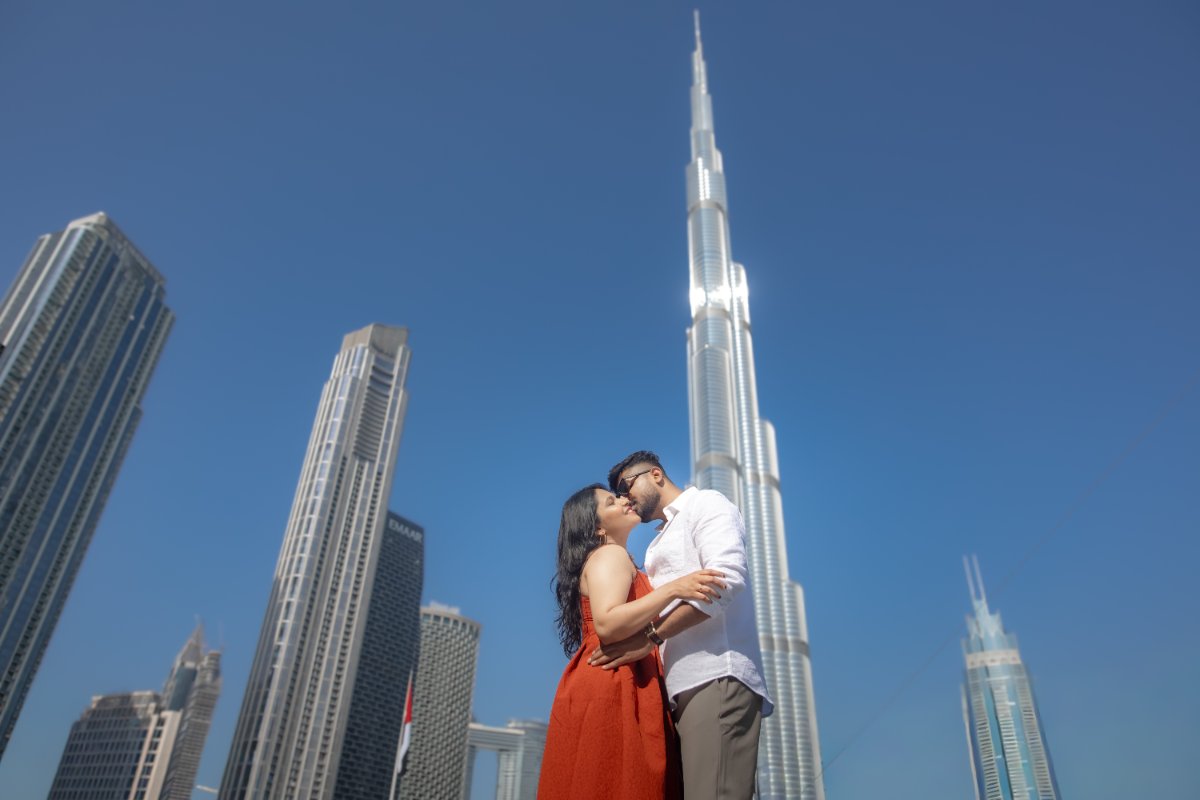
Everything we have written about Business Bay so far has argued for altitude. This piece argues the other way.
Canal level — the Marasi promenade, the water's edge, the bridges, the podium decks that step down to it — is in shade during golden hour and will never have the light that floor 75 has. We have done that arithmetic at length. And yet a large share of our favourite Business Bay frames were made down there, at water level, in shadow.
The reason is that canal level is not competing for golden hour. It has a completely different window, it runs on different physics, and it opens when the high floors are already finished.
Water level runs on reflected light
Once the sun drops below the western towers — which at canal level happens far earlier than sunset, typically 60 to 95 minutes before it — the promenade is no longer lit by the sun at all. It is lit by three things:
- The sky dome, which is a very large, very soft, slightly blue source directly overhead.
- The towers themselves, whose upper floors are still in direct sun and are throwing warm light back down and across the water. This is the crucial one, and it is why the light at canal level is warmer than a light meter suggests it should be.
- The water, which at canal level is a horizontal reflector roughly the width of the district, kicking sky and tower light back up under the chin.
That combination — cool from above, warm from the side, soft fill from below — is genuinely flattering, and it is nothing like the harsh direct light happening simultaneously 250 metres up. It is the reason a canal-level portrait shot at 17:20 in December and a rooftop portrait shot at 17:25 the same evening look like they were taken in different countries.
Arriving at the canal at sunset. By then the useful window has been running for over an hour and has about 20 minutes left in it. Canal level peaks before sunset, not at it — and then peaks again, differently, during blue hour.
When canal level actually works
The table below gives the two windows we schedule around. "Shade onset" is the approximate time direct sun leaves the central promenade — it varies by fifteen minutes or so depending on exactly where you stand and what is west of you. "Soft window" is shade onset to sunset, the period when the reflected-light setup above is at its best.
| Month | Shade onset | Sunset | Blue hour | Soft window | Conditions |
|---|---|---|---|---|---|
| December | 16:20 | 17:32 | 17:32–17:57 | ~72 min | Best of the year — low sun rakes the water |
| January | 16:35 | 17:51 | 17:51–18:15 | ~76 min | Excellent; clear air, long reflections |
| February | 16:55 | 18:13 | 18:13–18:36 | ~78 min | Very good; haze begins late month |
| March | 17:05 | 18:28 | 18:28–18:51 | ~83 min | Good; warm enough for evening comfort |
| April | 17:15 | 18:42 | 18:42–19:05 | ~87 min | Good, but heat starts to bite by mid-month |
| May | 17:25 | 18:56 | 18:56–19:21 | ~91 min | Long window, punishing conditions |
| June | 17:35 | 19:10 | 19:10–19:36 | ~95 min | Longest window, worst humidity |
| July | 17:35 | 19:12 | 19:12–19:37 | ~97 min | Avoid — haze flattens the skyline |
| August | 17:20 | 18:54 | 18:54–19:18 | ~94 min | Avoid — humidity and dust |
| September | 16:55 | 18:23 | 18:23–18:46 | ~88 min | Improving; still humid |
| October | 16:35 | 17:52 | 17:52–18:15 | ~77 min | Good; conditions turn pleasant |
| November | 16:20 | 17:31 | 17:31–17:55 | ~71 min | Excellent; season proper begins |
Sunset and blue hour computed for 25.1855°N, 55.2625°E. Shade onset is estimated from tower geometry on the central Marasi stretch and should be treated as approximate; a plot with open western aspect holds direct sun 20 to 30 minutes longer.
Two things jump out of that table. The soft window is longest in June and July — 95-odd minutes — and those are the two months we most strongly advise against shooting outdoors in Dubai at all. Humidity and airborne dust in high summer reduce contrast across distance, and the far side of the skyline, which is the entire reason to shoot at the canal, turns to grey soup. A long window full of bad air is worth less than a short window of clear air.
The other is that November through February give you 71 to 78 minutes of clean, comfortable, low-haze soft light, with a sunset early enough that a session can finish and still deliver a couple to a 19:30 reception unhurried. That is the season, and December is the pick of it.
Blue hour is the canal's real prize
The 23 to 26 minutes after sunset are when canal level stops being the compromise option and becomes the best location in Business Bay, full stop.
During blue hour two light sources cross over: the sky is falling, and the towers' architectural lighting is coming up. There is a period — in our experience roughly eight to twelve minutes wide, centred about ten minutes after sunset — where the two are within a stop or so of each other. Before it, the sky overpowers the buildings and the skyline looks dead. After it, the buildings overpower the sky and you get bright windows on a black field.
Inside it, everything holds: the sky retains deep blue, the towers read as illuminated, the water carries both, and a couple lit with a single small warm source separates cleanly from all of it. That frame is why people book Business Bay.
We are in position, composed and focused, before sunset — not walking to the spot at sunset. The crossover window is too narrow to find on the night. We also bring our own warm light for the couple, because the promenade's ambient lighting is uneven and colour-inconsistent, and matching it is slower than overriding it.
What canal level gives that height cannot
- Movement. Walking frames, a couple crossing a bridge, a dupatta lifting on the water breeze. High-floor sessions are static by nature; you have one vantage and you stay in it.
- Scale. Shooting up from the waterline with towers rising behind a couple gives a sense of size that a photograph taken 250 metres up cannot — up there, everything is below you and the scale collapses.
- Reflections. Still water at the eastern end of the promenade doubles the skyline. This is worth planning around: it works best on a low-wind evening, and wind in Business Bay is typically calmest in the hour after sunset.
- Access. No building management, no permit conversation for ordinary personal photography, no lift timing, no wind. You can be flexible in a way that a rooftop session simply does not allow.
The pairing that actually works
We rarely shoot canal level alone, and we rarely shoot high floors alone. The sequence that gets the most out of a Business Bay evening, using December's numbers:
- 16:20–16:55 — canal level, soft window opens. Walking frames, movement, family groups if there are any.
- 16:55–17:05 — lift up. This is the tightest logistic of the evening and it is rehearsed.
- 17:05–17:32 — high floor, the golden window. Direct sun, rim light, the district below.
- 17:32–17:45 — back down.
- 17:45–17:57 — canal level, blue-hour crossover. The postcard frame.
That is roughly ninety minutes for two locations, two entirely different light conditions and one lift ride, and it only works because every number in it came out of the almanac rather than out of a guess. The version of this that fails is the one where everybody arrives at sunset.
More on the upper half of that sequence in shooting above the shadow line, and on compressing the middle section in Dubai's 33-minute golden hour. If you would like your own evening planned to this level of detail, come and talk to us.