The single most useful sentence we can give a couple planning a Business Bay shoot is this: in this district, height beats location.
A plain balcony on the 70th floor will out-photograph a beautiful podium garden at golden hour, every single time, and it is not a matter of taste. It is because the podium garden is in the shadow of a tower two kilometres west and the balcony is not. We set out the arithmetic in the Business Bay Light Line; this piece is about what to do with it.
The five altitude tiers
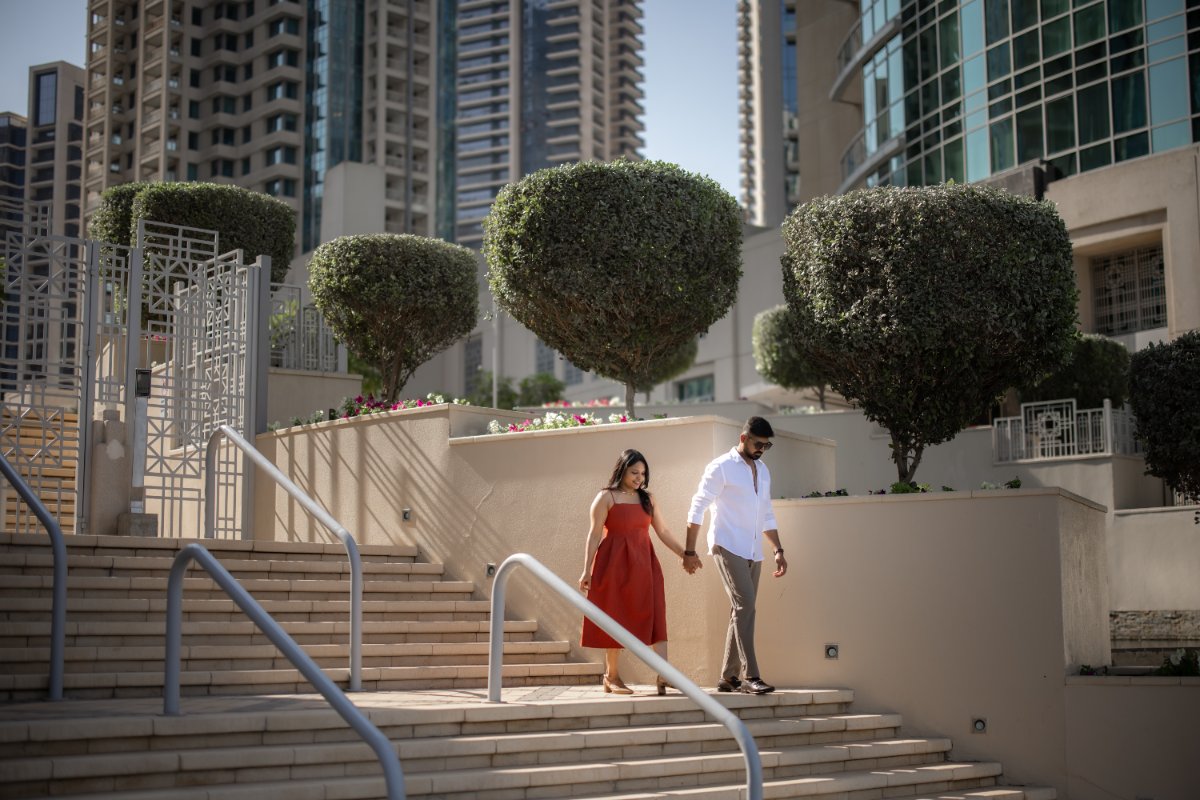
Business Bay is not one location. For a photographer it is five, stacked vertically, and they behave so differently that they may as well be different cities.
| Tier | Floors | Direct sun at golden hour | Light character | What bites you |
|---|---|---|---|---|
| Roof deck / 250 m+ | F78+ | Full golden hour, all 33 minutes | Direct low sun, hard rim light, full skyline horizon | Permit + building management; wind above 200 m |
| High floor 180–250 m | F56–F78 | Last 15–25 minutes only | Sun appears from behind the western blocker mid-window | Glass reflections; balcony depth cuts the frame |
| Mid floor 100–180 m | F31–F56 | None in central blocks | Bright open shade, warm sky above, cool light below | Colour cast from adjacent gold-tinted glass |
| Podium 30–100 m | F9–F31 | None | Flat shade, strong bounce off facing towers | Mixed colour temperature; deep contrast pockets |
| Ground / canal 0–30 m | G–F9 | None after ~16:40 in Dec | Blue-dominant open shade | Needs fill or a deliberately cool grade |
"Central blocks" means the dense core between Marasi Drive and Sheikh Zayed Road, where tower gaps are typically 40 to 150 metres. Peripheral plots with open western aspect behave one to two tiers better.
Note what happens between tiers two and three. Somewhere around 180 metres there is a hard edge — a floor above which you have a golden hour and below which you simply do not. In most central Business Bay towers that edge falls between floors 55 and 75, and it moves upward by roughly four storeys over the final forty minutes.
The mid-window reveal
The most interesting tier to shoot is the second one, 180 to 250 metres, and it is the one nobody plans for.
Here the light line climbs past you during the session. You start in shade. Then, usually 15 to 25 minutes before sunset, the sun clears the shoulder of the tower to the west and the room floods with hard, low, orange light for a few minutes before the sun sets properly. It is the most dramatic light available anywhere in the district and it lasts a fraction of the time people assume.
Two cameras, pre-set. One metered for the shade you are standing in, one metered three-and-a-half stops down for the moment the sun arrives. There is no time to change settings when it happens — the transition from full shade to direct sun on a high floor takes under ninety seconds, and the best frame is usually in the first twenty.
We find this reveal by scouting the same floor at the same clock time the day before. The sun's altitude at a given number of minutes before sunset is almost identical from one day to the next, and — as the almanac shows — almost identical from one season to the next. Yesterday's rehearsal is an extremely good prediction of today's shoot.
Call times, by tier
These are the schedules we actually put on a Business Bay call sheet. T is sunset, taken from the almanac for the month in question.
| Tier | Crew on location | Couple in position | Wrap |
|---|---|---|---|
| Roof deck / 250 m+ | T−75 min | T−40 min | T+20 min |
| High floor 180–250 m | T−60 min | T−25 min | T+20 min |
| Mid floor 100–180 m | T−50 min | T−35 min | T+25 min |
| Podium 30–100 m | T−45 min | T−30 min | T+25 min |
The gap between crew arrival and couple arrival is not padding. On a high floor it is spent finding the exact spot where the light will land — which is a different spot from where it is landing when you arrive, because the line is still climbing.
Getting up there
Altitude in Business Bay is an access problem before it is a photographic one. Roughly how it breaks down:
- Hotel rooms and suites. The most reliable high-floor access in the district. A room on a high floor with a western or northwestern aspect, booked for the night, solves the permission problem entirely and gives you a getting-ready location as well. This is what we recommend most often.
- Residential balconies. If the couple or a family member lives in a Business Bay tower, this is free and excellent. Check the aspect — a northeast-facing balcony is worthless for sunset regardless of floor.
- Rooftop venues and terraces. Excellent light, but they are commercial spaces with their own rules; expect to book, expect a minimum spend, and expect restrictions on tripods and lighting stands during service hours.
- Building roofs proper. These require building management permission and, for anything commercial, appropriate filming clearance. Plan this weeks ahead, not days. Above 200 metres, wind is a real constraint — veils, dupattas and lehenga trains become unmanageable, and that is a creative decision as much as a safety one.
Rules for commercial filming and photography in Dubai change, and they vary by property, by freehold community and by whether the shoot is deemed commercial. We do not publish a permit checklist because any version we wrote would be out of date within a season. What we do is confirm access in writing with the specific building for the specific date, every time. Ask any photographer you are considering how they handle this; the answer tells you a lot.
What high floors do to your images
Three things change once you are above the light line, and only one of them is the obvious one.
1. The light gets harder, not softer
People expect golden hour to be soft. Up above the shadow line it is not — it is direct, unobstructed, low-angle sun with no atmosphere-thickened diffusion, because you are looking at it through less atmosphere than someone at ground level. Rim light is sharp. Shadows under the brow and nose are deep. You need a scrim or a reflector far more often at 250 metres than at 25 metres, which is the opposite of what most people pack for.
2. The background stops being a background
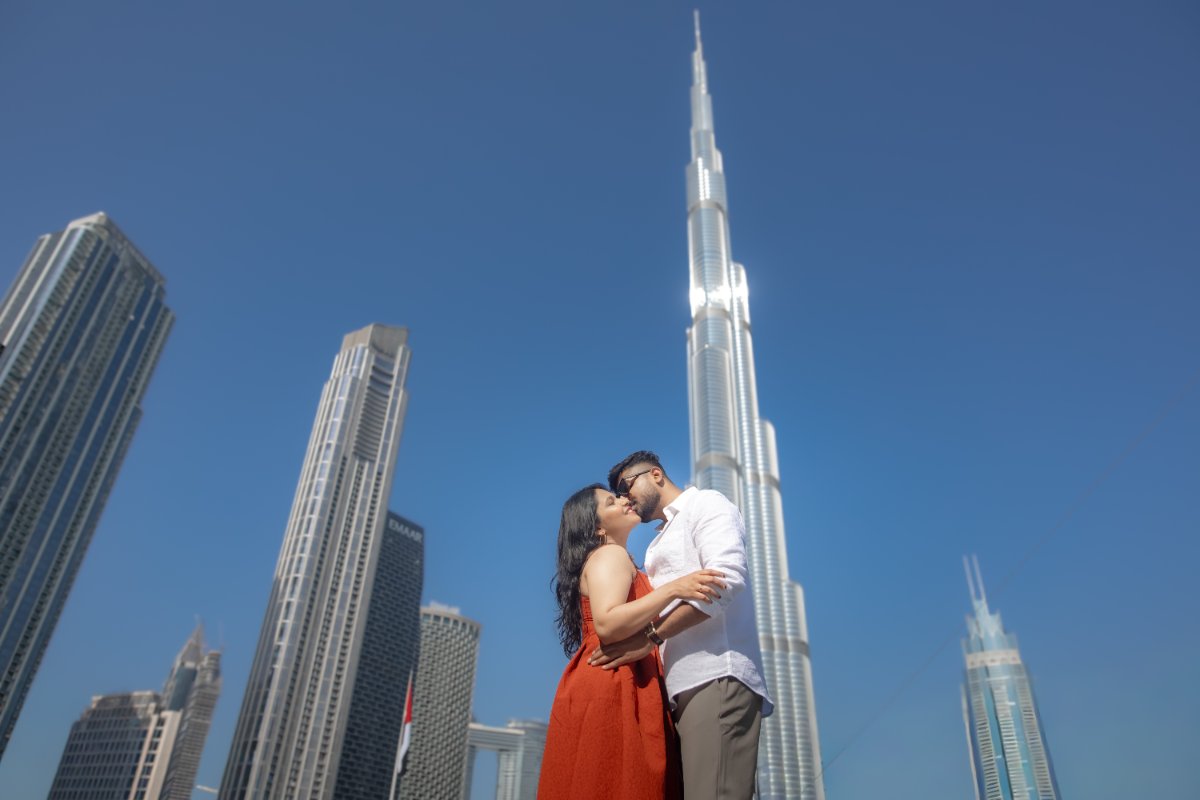
At ground level the skyline is above the couple. At 250 metres it is behind and below them, which changes the entire compositional logic. Horizon lines land at chest height. You can shoot slightly downward and put the whole district under the couple, which is the frame that only this tier gives you and the reason it is worth the access hassle.
3. Glass gets in the way
Most high-floor access in Business Bay is behind glass, and Business Bay glass is heavily tinted — frequently with a green or bronze cast that no white balance preset fully removes. Shoot through an open door where one exists. Where it does not, get the lens element flush against the glass to kill reflections, and expect to spend real time on the grade.
The honest trade-off
High-floor shooting in Business Bay buys you light and a background nobody else has. It costs you access, wind, glass, and the ability to move — you get one vantage point and you keep it for the whole window. Ground-level shooting costs you the light entirely but gives you movement, variety, water, and architecture at human scale.
Which is why we almost never do one or the other. The pattern that works is ground level for the 90 minutes before the window, high floor for the 33 minutes of the window itself, and blue hour back at ground level where the tower lighting is the subject rather than the sun. That sequence needs one lift ride timed to the minute, and it is the single most-rehearsed logistic on any Business Bay shoot we run.
For the underlying numbers see the Business Bay Light Line. For what the bottom of the stack is capable of, see canal level. And if you want this planned properly around your date and your building, get in touch — our studio is five floors up in Bay Square, which is exactly low enough to have taught us all of this the hard way.