
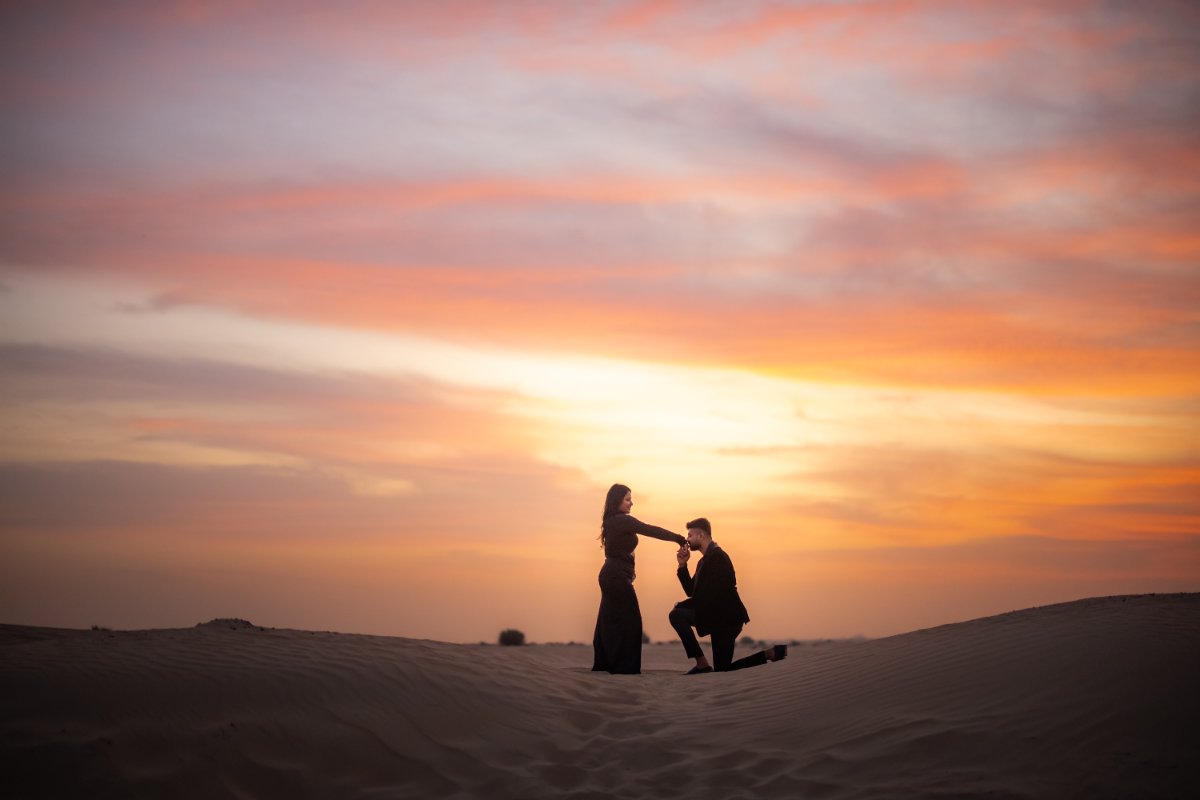
A photographer who trained in London arrives in Dubai, books a couple session for golden hour, and blocks out an hour. Forty minutes of that hour do not contain golden hour. This happens constantly, and it is not carelessness — it is a reasonable assumption imported from a latitude where it is true.
In Business Bay the golden window is 33 minutes. It is 34 minutes in January and 33 in June. It does not meaningfully lengthen in summer, because that is not how the geometry works.
Why it is so short
Golden hour is not a duration, it is a distance the sun travels — from 6° above the horizon down to it. How long that takes depends entirely on the angle at which the sun's daily path meets the horizon, and that angle is set by latitude.
At 25°N, the sun's path is steep — near the equinoxes it meets the horizon at roughly 65 degrees — and it punches through the last 6° of altitude at about 0.2° per minute. At 51°N the path is far shallower, so the sun slides toward the horizon at an angle rather than dropping onto it, and the same 6 degrees take close to an hour.
| City | Latitude | Golden hour, December | Golden hour, June | Seasonal swing |
|---|---|---|---|---|
| Business Bay, Dubai | 25.2°N | 34 min | 33 min | 1 min |
| Bangalore | 13.0°N | 31 min | 31 min | 0 min |
| Mumbai | 19.1°N | 32 min | 32 min | 0 min |
| Udaipur | 24.6°N | 34 min | 33 min | 1 min |
| Toronto | 43.6°N | 47 min | 44 min | 3 min |
| London | 51.5°N | 62 min | 54 min | 8 min |
Business Bay figures computed for 25.1855°N, 55.2625°E. Other cities are approximate values for the same 6°-to-horizon definition, given for comparison of magnitude rather than for scheduling.
Two things are worth pulling out of that table. The first is the obvious one: London gets roughly twice the golden hour Dubai does, in either season. A photographer who has internalised an hour is not being careless when they book one — they are being accurate about somewhere else.
The second is the last column. Dubai's window varies by a single minute across the entire year; London's varies by eight. Latitude sets not just how long the window is but how much it moves, and low-latitude cities barely move at all. Note also that London's December window is longer than its June one — in deep winter the sun's whole arc is shallow, so it takes longer to cross the last six degrees even though there is far less daylight overall.
The Indian cities in that table sit much closer to Dubai than to London, which is why photographers working between India and the UAE adapt quickly, and photographers arriving from Europe frequently do not.
Summer does not help. June has a 13h 42m day and a 33-minute golden hour. December has a 10h 35m day and a 34-minute golden hour. The long summer day gives you more light overall and slightly less golden light. Booking a June wedding for a longer sunset session is a mistake based on a real but irrelevant fact.
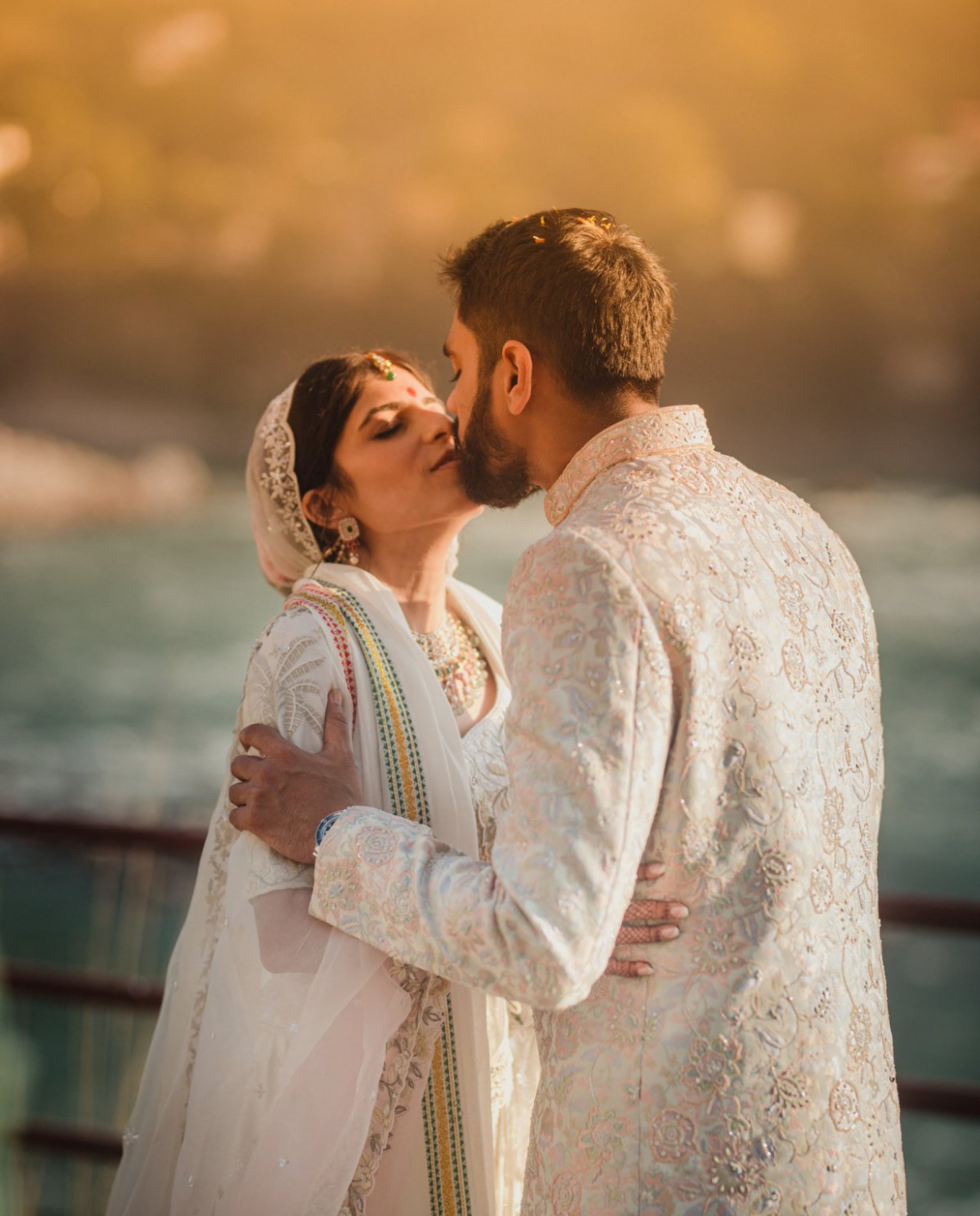
Running a full session in 33 minutes
This is the schedule we work to. T is sunset, from the almanac for the relevant month. The whole thing is written as a countdown because the clock time changes month to month but the countdown never does.
| Time | What happens | Frame | Note |
|---|---|---|---|
| T−35 | Couple in position, first setup framed | Wide establishing frame, flat light | Pre-focused, both bodies metered |
| T−30 | Window opens — sun at 6° | Hero portrait, backlit | Do not move. This is the frame. |
| T−24 | Second angle, same spot | Tighter, 85–135 mm | Rotate the couple, not the camera |
| T−18 | Move — setup two | Rim-lit walking frames | Under 90 seconds of walking |
| T−12 | Setup two, hero | Sun on the horizon line | Lowest, warmest, hardest light |
| T−6 | Detail and hands | Rings, dupatta, texture | Light is going fast now |
| T−0 | Sunset | Silhouette frames | Expose for sky |
| T+6 | Reposition for blue hour | Skyline composition | Tripod up, shutter dropping |
| T+12 | Blue hour crossover | The postcard frame | Add warm key light on the couple |
Three principles hold that schedule together.
Two setups, not five
The single most common way a Dubai couple session fails is over-ambition about locations. Thirty-three minutes supports two setups. A third is possible only if it is within ninety seconds' walk. Every additional location costs roughly six minutes of walking and re-framing, which is 18% of the entire window — and it is always the best light that gets spent on the walk, because the light improves as the window runs down.
Everything solvable is solved beforehand
Outfit changes, hair and makeup touch-ups, ring boxes, the flowers, the dupatta pinning — none of these happen inside the window. They happen in the ninety minutes of flat light before it, which is also when we shoot the getting-ready coverage, the detail frames and any group photographs. By the time the window opens the couple should have nothing to do but be photographed.
The last ten minutes are the best ten minutes
Sun altitude drops from about 1.2° to 0° in the final ten minutes, and that is when the light is lowest, warmest and most directional. Photographers who front-load the session and start packing at T−10 systematically miss the best frames of the evening. We plan the hero frame for T−12, not T−30.
Sunset is not the end of the evening. Blue hour runs another 23 to 26 minutes and in Business Bay it is arguably the stronger window — see canal level. Sessions that wrap at sunset throw away the district's best asset.
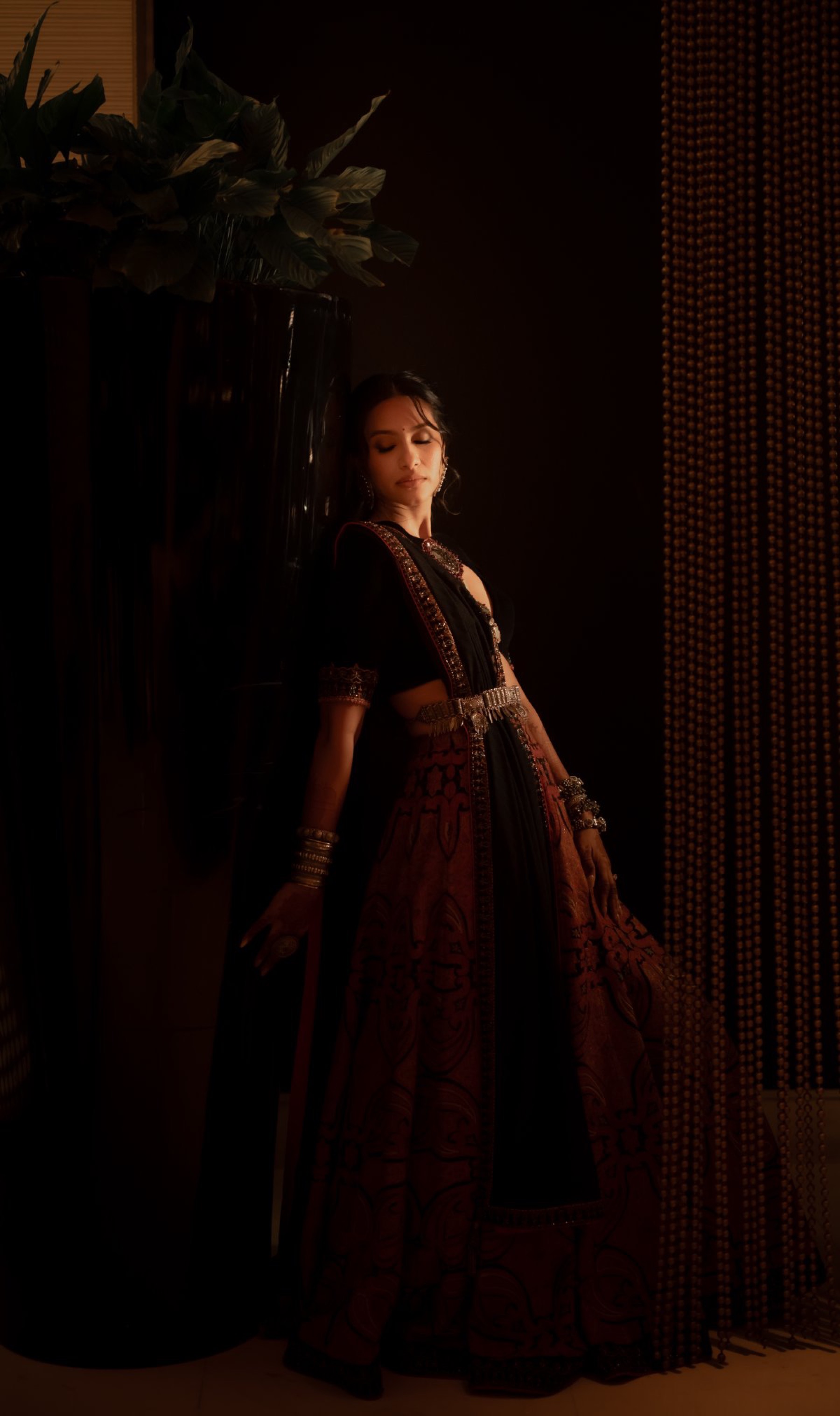
What this means if you are planning a wedding
- Protect the window contractually. If your photographs matter to you, the 33 minutes before sunset should be blocked in the wedding schedule and defended from the timeline creep that eats it. Speeches, entries and cake cuttings can move. Sunset cannot.
- Do not schedule the couple session and the reception entry back to back. The window ends at sunset and blue hour ends 25 minutes later. An entry called for fifteen minutes after sunset forces a choice between the best frames and being on time.
- Ask for the countdown, not the clock time. Any photographer who knows this district will give you a schedule relative to sunset. One who gives you fixed clock times without checking the date has not thought about it.
- Choose a winter date if the skyline matters. Not for the light duration, which barely changes, but for air clarity and for a sunset early enough that the session does not collide with the evening's events.
The short version
Thirty-three minutes, twice a day, every day of the year, almost unvarying. In a district where most of those minutes are only available above the 70th floor, that is a small and specific target, and hitting it is mostly a planning problem rather than a photographic one.
You cannot make the window longer. You can only stop wasting it.
The full computed data is in the Business Bay Light Line. If you would like your day built around these numbers rather than around an assumption, talk to us.